John Brigham
Needful ThingsJohn Brigham is the Catholic priest who proposes Casino Nite as a fundraiser for Our Lady of Serene Waters. His plan places a modest church benefit at the center of Castle Rock’s growing Catholic–Baptist conflict, and his longstanding antagonism with Reverend William Rose makes the disagreement more than a dispute over gambling. At the end of the town’s violent breakdown, Brigham finds Rose amid the disorder and helps him up, a small but consequential reversal of the hostility that had helped define their public conflict.
Identity and role
Known as Father Brigham and, in the town’s informal shorthand, Irish Johnny Brigham, John Brigham is associated with Our Lady of Serene Waters and the Catholic community. The available scenes present him chiefly through public religious life: he proposes a fundraiser, becomes the target of Rose’s objections, and later appears alongside him during the aftermath of the town’s violence. His role is therefore both institutional and personal. The fundraiser concerns the church’s needs, while the rivalry with Rose makes Brigham a recognizable participant in the broader sectarian tension.
Casino Nite and the dispute with Rose
Brigham comes up with the idea for Casino Nite, planned for the Knights of Columbus Hall on the last Thursday of the month. Its proceeds are intended to help pay for repairs to the roof of Our Lady of Serene Waters. The Daughters of Isabella take the lead in organizing it, with Betsy Vigue singled out as especially enthusiastic. The planned evening combines small-stakes games and prizes with the prospect of a lively social occasion; to its organizers, the activity is a limited church benefit, not an effort to provoke a religious fight.
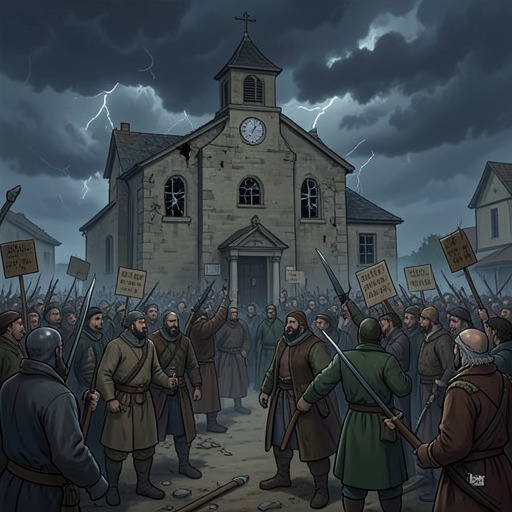
Reverend William Rose sees the event very differently. Brigham and Rose already dislike one another, and Rose knows that Brigham originated the mocking nickname “Steamboat Willie.” When Rose hears of the casino fundraiser, he responds by paying for DICE-AND-THE-DEVIL flyers, which are posted around town by Wanda Hemphill and her sewing-circle companions. The two congregations’ quarrel then spills into the local newspaper’s letters column, where Catholics and Baptists trade accusations about one another’s moral standing. Brigham’s proposal thus becomes the immediate issue around which older personal and communal resentments gather.
Legal argument and moral opposition
Rose challenges the legality of Casino Nite as well as its morality, arguing that the event involves gambling for money. Brigham’s position is conveyed through the explanation given by Alan Pangborn: participants make a donation at the door and receive an equal amount of play money; prizes, rather than cash, are auctioned at the end. The examples include a VCR, a toaster oven, a Dirt Devil, and a set of china. Alan also notes that the initial donation may be tax deductible, while distinguishing Rose’s condemnation as a moral judgment from the legal question.
The dispute exposes the gap between the event’s practical design and its religious meaning for Rose. A workaround intended to keep the benefit within the law does not answer his objection that the activity is sinful. Conversely, Rose’s denunciation does not make the fundraiser illegal. Brigham’s plan is caught between those registers: it is a church-repair effort organized through a format that its supporters regard as permissible, but which opponents interpret as a violation of religious principle. As the argument widens, the proposed games become a visible symbol onto which the town’s existing divisions can be projected.
Final-night reversal
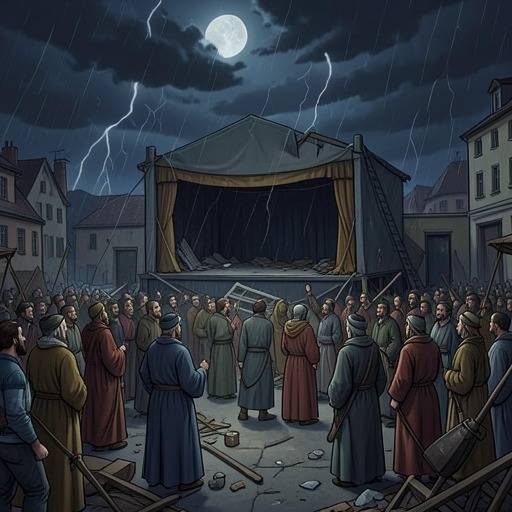
During the final night of violence, the conflict between Catholics and Baptists turns into physical disorder on Castle Avenue. When a major blast interrupts the fighting, Henry Payton looks toward the fireball, and Rose begins to fear that the end of the world has arrived. Brigham approaches him in a drunken, unsteady state. Although he appears to consider striking Rose, he instead helps the injured minister to his feet. The gesture does not erase their earlier antagonism, but it interrupts its expected course: at the moment when the town’s divisions have become dangerous, Brigham responds to Rose as someone who needs help rather than as an adversary.
Afterward, Polly Chalmers points to the scattered religious participants as an example of how the town’s quarrels have been set in motion by forces beyond any one person. In that account, Brigham appears supporting Rose, while Nan Roberts has her arm around Henry Payton. The image places Brigham and Rose among people beginning to move apart from the violence, with some leaving alone and others together. Their brief cooperation is not presented as a formal reconciliation, but it stands in contrast to the antagonism that had fueled the Casino Nite controversy.
Narrative significance
Brigham’s plot function is concentrated in a chain of escalation and reversal. His fundraising idea gives the religious dispute a concrete occasion; Rose’s campaign against it turns that occasion into public antagonism; the dispute contributes to a climate in which local religious identities become entangled with broader hostility. The story also resists making Brigham’s role a simple moral verdict. The fundraiser can be defended as a bounded effort to repair a church, while its opponents experience it as an offense; neither position prevents the conflict from becoming a vehicle for manipulation and violence.
The final gesture toward Rose supplies the sharpest counterpoint. Brigham has helped create the immediate subject of their quarrel, and his past rivalry with Rose is explicit, yet at the crisis point he chooses assistance over the retaliatory impulse. That action does not undo the consequences of the town’s disorder or establish that the two men have settled their differences. It does, however, give their relationship a brief humane turn: the priest associated with the plan that intensified division becomes, at the end, the person who helps his opponent stand.